Saturday, February 25, 2012

Tanagers in Gonzales Park, Compton

Hi there! 
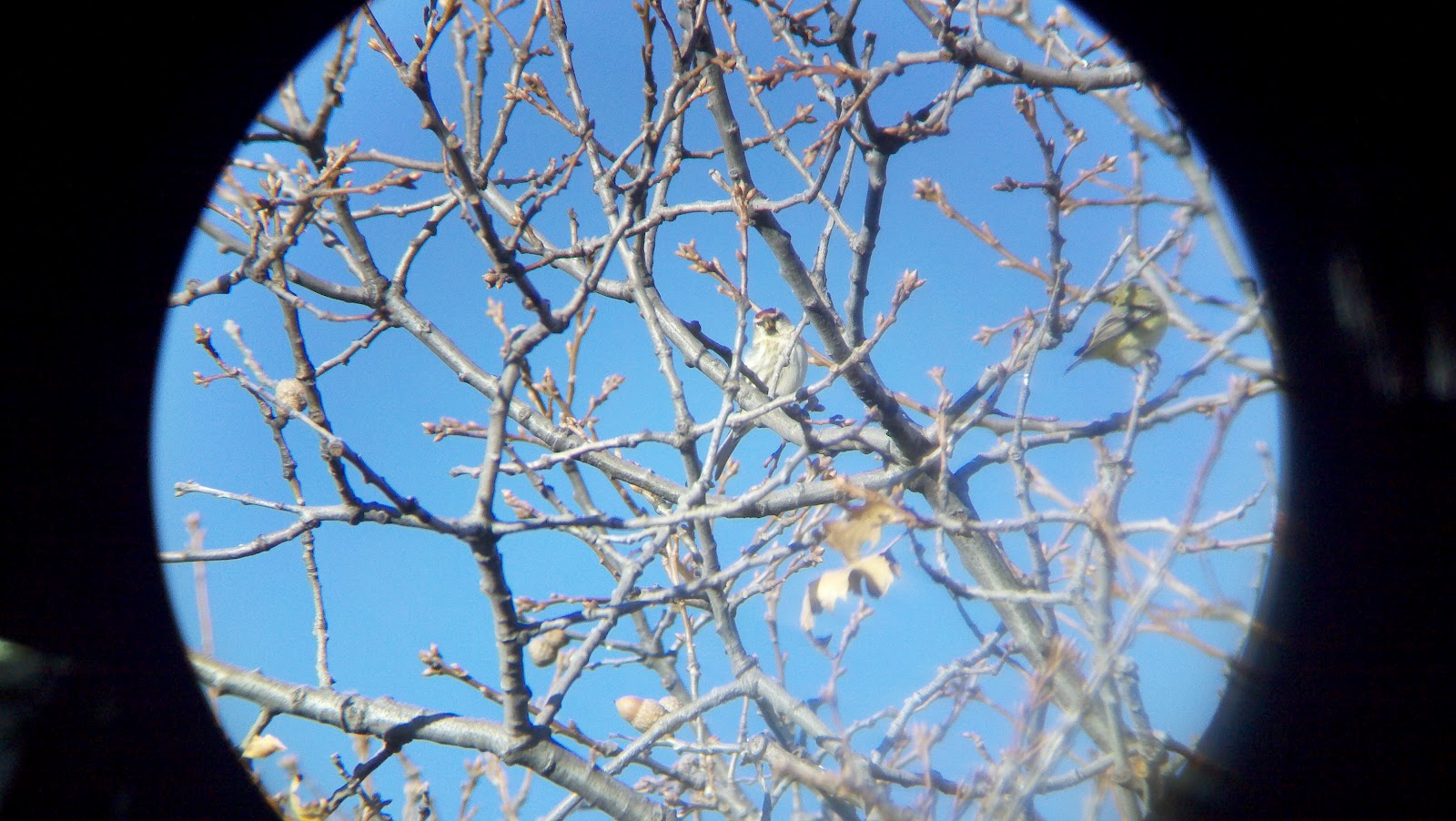
 I'm a Summer Tanager spending the winter in L.A.!
No pictures, please!  I am but a humble Hepatic Tanager.

By April, I'll be a pretty boy!


...And I'll still look like this.  Oh, bother.

Wednesday, February 22, 2012

Salton Sea February 19th, 2012

Wister Unit 8:00 a.m.
Much to his disappointment, Balázs didn't see any rattlesnakes.

BIRDS SEEN:
==========
Abert's Towhee
Black-tailed Gnatcatcher
Ladder-backed Woodpecker
Gambel's Quail
Red-wingedBlackbird
House Finch
Audubon's Warblers
one Myrtle Warbler
Inca Doves
Eurasian Collared Doves

Red Hill Marina 11:00 a.m.
American Herring Gull?  Okay, but we need a Yellow-footed Gull!
No Yellow-footed Gull, huh?  Too bad.
Dude, where's my Salton Sea?
The Salton Dea is drying up.  Its water source is being diverted to water golf courses in San Diego.  They are trying to save it.

John Thomlinson, Ph.D.
Biology Professor at California State University,        Dominguez Hills

Who do I run into, when I go to a party at Cathy Jacobs' house? John Thomlinson!

Who do I run into, when I chase a Scissor-tailed Flycatcher in San Pedro? John Thomlinson!


Who do I run into, when I go to a party at Cathy Jacobs' house? John Thomlinson!
 
Who do I run into, when I chase a Gyrfalcon in Riverside? John Thomlinson!


I can't get away from the guy!


Laughing Gull at the end of Lack Road 5:30 p.m.

István kept pronouncing "Laughing Gull" as "Lo-fing Gull".  Lo fing is Hungarian for "horse fart".

Saturday, February 4, 2012

Common Redpoll in San Diego County (of all places)

Zsezse San Diego Megyeben 

 At 11:55 a.m. today, I was baking chicken for my kids while doing the dishes.  Little did I suspect that 3 hours later I would be in Julian, a quaint tourist trap in the mountains of rural San Diego County, staring at a Common Redpoll.
Ez igen!
     Then the phone rang.  After my friend told me about the Redpoll being found at the parking lot bird feeders of a bird feeder store in downtown Julian I yelled at my kids, "ROAD TRIP!!!"
Ennye, ennye, Zsezse.  Neked a Hortobágyon kellene lenned!

      The usual crowd of birders were standing the The Birdwatcher's parking lot when we pulled to a stop, and parked.
     After admiring the bird for an hour, I went inside their shop, and bought some gifts for a couple of friends who are birders.  My way of expressing my appreciation.Wow, I didn't expect to get a life bird this weekend.  Certainly not a Redpoll this far south.
    

Sunday, January 29, 2012

Losing Dad

    When I was working in the Radiation Safety Office at USC, I walked over to help a marine biologist, with the improbable name of Jeb Fuhrman, who couldn't get the campus-wide computer network to update his inventory of radioactive chemicals.
     I said, "Hey, I'm going to stand here, right behind you, and watch.  You have the font set too small on your computer."
     He peered up at me through glasses that looked like a matching pair of magnifying lenses, and groused, "How old are you?"
     "Forty.  Why?"
     He swiveled away from me and said, "Yeah, that's when it happens."


     A couple of weeks later I was the proud owner of a set of prescription reading glasses.


     My father died when I was 22 months old.  I don't remember him.  I have a few things of his: his East German 35 mm film camera, a brass button from his Hungarian army uniform, his wedding ring from when he was married to my mom (it is now my wedding ring for being married to my wife), his cuff links, and his glasses.  Lately, through a miracle of heredity, I have been able to wear his glasses. 


     Wow, I'm wearing Dad's glasses.  And they work perfectly for my eyes. Interesting, how we like to wear somebody else's stuff: a kid wears his dad's coat, a wife wears her husband's shirt.  It really does make you feel closer to that other person.


     So, of course, this week I put the glasses on, and the frame broke.  It exploded.  It flew apart with a dry crunch that only 50 year old plastic can give.


    My first instinct was to keep them, anyway.  Logic prevailed, and after I snapped a picture, I threw them out.  What you don't see in this photo are the multiple small shards of plastic from when the frame exploded.  Still, the act of tossing my father's glasses into the kitchen trash can was painful.

     The same thing happens to Oskar Schell in "Extremely Loud & Incredibly Close".  The movie trailers and newspaper advertisements make it clear that this movie is about a kid who lost his father--played by Tom Hanks--on 9/11.  Despite knowing this, and knowing that the movie is about how young Oskar sets out on his journey to heal his soul by connecting with others who knew his father, I wanted to see what happens.  I wanted to see how the story unfolds.  I'm glad I went to see this movie. 

     I remember where I was when 9/11 happened.  I was married to my first wife, and it was two months since my mom had died.  I was getting ready to go to work, making coffee in the kitchen, while listening to the local NPR station, KPCC, which used to broadcast from the campus of Pasadena City Collge (hence the name KPCC).  They announced that a large plane had crashed into the World Trade Center.  Well, that was weird.  I went into the living room, turned on the TV, and saw the second plane crash into the second tower.

     I could kiss the screenwriter, Eric Roth.  I hope they give him an Oscar for best adapted screenplay.  He didn't make the movie unbearably saccharine e.g. a post-9/11 version of "Terms of Endearment".  The lady in the row behind me said to her husband, "This was intense."  Good description.  I'd like to know what all of the room-temperature IQ film critics out there were smoking when they wrote their scathing reviews of tis movie.  They're idiots.

Saturday, January 28, 2012

Claremont: Rancho Santa Ana Botanical Garden

Pipevine Swallowtail, Battus philenor
No wonder people hate California: It's January, and swallowtails are flying around.  I was surprised to see Pipevine Swallowtails in Claremont--let alone in January.
Red-shouldered Hawk, Buteo lineatus
American Robin, Turdus migratorius
Never was a bird more aptly named.  Its Hungarian name, Vándor Rigó, literally tranlates as "wandering thrush".

Sunday, January 22, 2012

Seal Beach National Wildlife Refuge

Nelson's Sharp-tailed Sparrow
These guys are notoriously difficult to see--let alone photograph.  The reason for the trip, today, was the ultra-high tide that flushes them out of their hiding spots in the marshes.


Great Blue Herons

Long-legged Singer (left), Bearded Sosensky (center), Bucolic Benson (right)
Peregrine Falcon, Falco peregrinus

 Ferruginous Hawk, Buteo regalis
Reddish Egret, Egretta rufescens
Coyote, Canis latrans


Lapland Longspur (center) among Horned Larks

Green Sea Turtle, Chelonia mydas

Oh, man!  I have been promising myself for 3 years that I am going to go see these guys.  They are a resident colony that was discovered in the San Gabriel River, 2 miles upstream from the Pacific Ocean, in 2008.They are HUGE!  Seriously, they're humoungous.  The adults' head was around the size of an American football.  Csaba and Istvan saw their entire body.  The problem is that trying to photograph them when they momentarily surface for a gulp of air is like playing "wack a mole".  First, you see one surface here, so you focus your camera at that distance, and wait for him to come up in the same area, but he pops up over there, at a different distance, you that by the time you adjust your focus, he's down under, again.  We spent an hour not getting pictures i.e. taking pictures of the water surface, with the turtle gone. 
female American Kestrel, Falco sparverius
Compare this little girl to the gigantic Gyrfalcon
Common Teal a.k.a. Eurasian Green-winged Teal
American scientists consider this and American Green-winged Teal to be two races of one species.  The American birds have a vertical white stripe, like the one on the left.  The Eurasian birds--like the one onthe right--have a horizontal stripe.  European scientists consider them to be two separate species.  Makes sense to me.

Thanks for finding the Common Teal, Istvan!


Saturday, January 21, 2012

Gyrfalcon

This, ladies & gentlemen, is a Gyrfalcon: Falco rusticolis.  It showed up at a wildlife refuge in Riverside County, California.  Here's the crazy thing: just in case it is an escaped falconer's bird, they don't want us specifying where exactly the bird is hanging out.

I don't think the bird is an escapee from a falconer for multiple reasons:

1) It is a juvenile.  Juvenile Gyrfalcons are known for vagrancy. They show up much further south than the adults.  That said, this is ridiculously fr south for a Gyr.
2) It is a brown bird.  Gyrfalcons used for falconry are the white morph birds of the high arctic. For an intellectual exercise, I went on the internet to buy a Gyrflcon.  There are not a lot for sale, and they are very expensive. The odds of some dumb guy losing his $50,000 imature brown bird are absurd in totum.

3) The bird that showed up in Orange County was an adult white Gyrfalcon with a jess on its leg.  Enough said.  Click here to see photographs and read about that obvious escapee.

4) It's not wearing a jess, or other falconry equipment.

4) The length of the tail vs the wingtips.  A very knowledgeable bird expert (who I know, like, and respect) pointed out that the bird's primaries i.e. wingtips should be proportionately much shorter, when compared to the length of the tail.  This raises the suspicion that this falcon is a captive-bred hybrid of Gyrfalcon with some other species.  I think it just happens to have long wings i.e. there is probably a lot more naturally occuring variation than we are aware of.  Otherwise, the plumage looks good.

The constant clicking of camera shutters was deafening.
  Rough-legged Hawk
Buteo lagopus

Rough-legged Hawk

Rough-legged Hawk perching on a thin branch.
Rough-legs are known for doing this, and are portrayed in this pose in many books.  Unlike other large hawks, they are light enough to do this.
Rough-legged Hawk
     Look closely at this hawk's legs: they are feathered all the way down to the toes, unlike other members of the genus Buteo.  This is because they live in the high north, where it is cold.  Eagles are essentially large hawks with feathered legs.  Gyrfalcons have this same oddity that separates them from other members of Falco. 
     DNA analysis has shown that falcons and hawks are not at all closely related.  Rather, they have arrived at the same hunting lifestyle through convergent evolution.  Unsurprisingly, falcons are related to parrots.

Western Meadowlark
Sturnella neglecta
Gyrfalcon (Falco rusticolis) and American Kestrel (Falco sparverius)
The Kestrel constantly harassed the Gyr.
That's like a Dachshund attacking a Pit Bull.
Note the size difference between North America's largest and smallest species of falcon, both in the genus Falco.  The species of kestrel found in the U.S., Mexico, and Canada is a different species from the bird simply called Kestrel in Eurasia.  Click here to see a beautiful close-up photo of an American Kestrel.  Click here to see a Eurasian Kestrel.
American Kestrels eat large insects like grasshoppers and dragonflies, and small birds like House Sparrows.  Gyrfalcons eat ducks and rabbits.
Lee Swanberg (left), retired teacher.
Lee and I have carried out winter bird censuses up in Mount Baldy's Ice House Canyon, together.

The smallest falcon I've ever seen is the Bat Falcon in the tropics. Yes, they eat bats.